
Table of Contents
- Moving Estimate vs Final Bill: Key Differences Explained
- Understanding Binding vs Non-Binding Moving Estimates
- Why Final Moving Bills Exceed Initial Estimates
- Identifying Hidden Moving Fees Before Moving Day
- How to Dispute Moving Charges and Resolve Discrepancies
- Factors Affecting Moving Costs: Distance, Weight, and Services
- Getting Accurate Estimates: Tools and Best Practices
- Conclusion: Protecting Yourself From Moving Estimate Surprises
Moving Estimate vs Final Bill: What You Need to Know
Last Updated: July 25, 2026
Understanding the difference between a moving estimate vs final bill is critical for planning a successful relocation. According to the Federal Motor Carrier Safety Administration (FMCSA), moving cost disputes represent one of the top consumer complaints in the residential moving industry. At ProTouch Mover, we’ve guided thousands of Jacksonville-area customers through this process. Below, we’ll show you how to protect yourself from bill shock and understand what separates a binding estimate from a non-binding one.
Moving Estimate vs Final Bill: Key Differences Explained
A moving estimate is a preliminary assessment of your move’s cost based on an inventory of your belongings and requested services. A final bill is the actual invoice you receive after the move, reflecting the true weight, distance, services rendered, and any additional charges that arose during relocation.
An estimate is generated during an in-home survey or virtual assessment, where a representative catalogs your items and calculates approximate costs. The final bill is based on actual data collected during your move: real weight, actual distance traveled, and services genuinely performed.
Request a detailed written estimate that breaks down labor costs, equipment fees, and service charges separately. This makes it easier to compare the estimate line-by-line against your final bill and identify discrepancies.
What Is a Moving Estimate?
A moving estimate is a non-binding or binding projection of moving costs provided before your move. It’s based on information about your household goods, origin and destination, and specialty services like piano moving or white-glove packing. Some are binding, meaning the final cost cannot exceed the quoted amount. Others are non-binding, meaning the final bill can be significantly higher if actual weight or scope of work exceeds the estimate.
What Is a Final Bill or Invoice?
A final bill is the itemized statement you receive after relocation is complete. It reflects actual costs incurred, including labor hours, equipment usage, actual weight, and any accessorial charges not anticipated during the estimate phase. The final bill is legally binding and must comply with FMCSA regulations requiring a bill of lading before your move begins. ProTouch Mover provides itemized invoices that clearly separate labor, transportation, and add-on services, preventing confusion that often leads to disputes.
Understanding Binding vs Non-Binding Moving Estimates
The type of estimate you receive fundamentally shapes your financial risk.
What Makes an Estimate Binding?
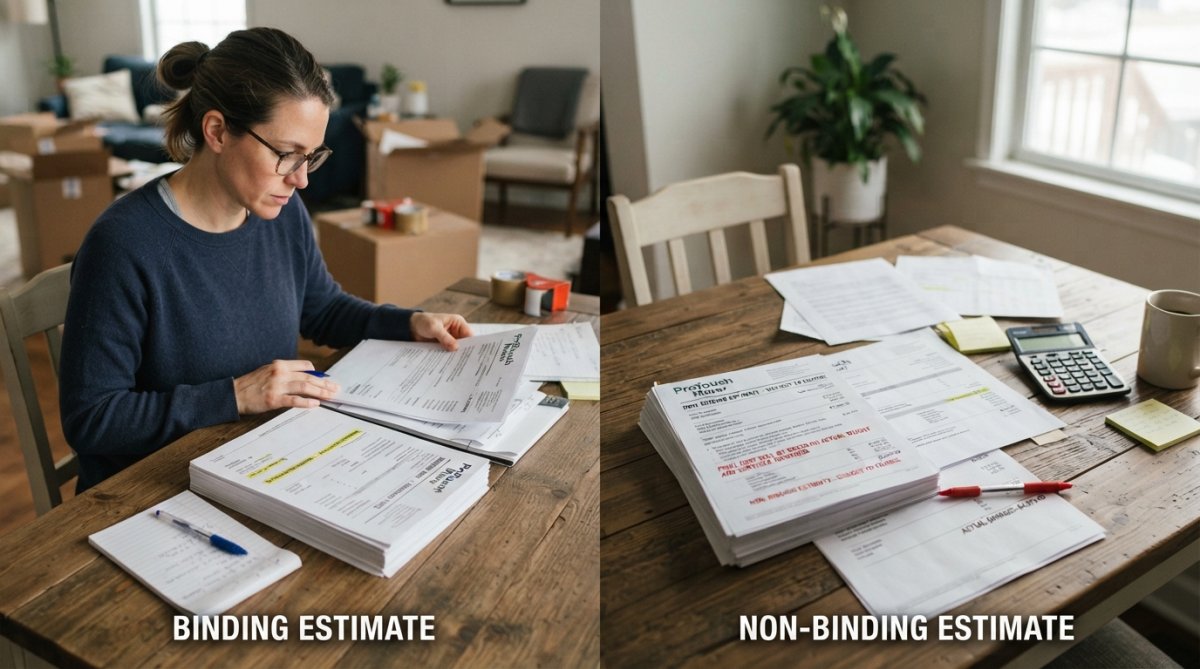
A binding estimate is a firm quote that cannot be exceeded without your written consent. Binding estimates require a detailed in-home survey where the representative inspects your home, counts items, measures furniture, and assesses access challenges at both locations. This thorough process generates a highly accurate estimate the company guarantees.
A binding estimate protects you from surprise charges on moving day. If you’re moving on a tight budget or have a fixed relocation allowance, a binding estimate is your best protection against bill shock.
How Non-Binding Estimates Work
A non-binding estimate is an educated guess based on information you provide, often without an in-home survey. The final bill can be higher if actual weight or scope of services exceeds the estimate. Non-binding estimates are cheaper upfront but carry significant risk. If your actual shipment weighs 15,000 pounds instead of the estimated 12,000 pounds, you could owe thousands of dollars more on moving day.
Binding Not-to-Exceed: A Middle Ground
A binding not-to-exceed estimate (BNTE) combines protections of a binding estimate with slightly lower upfront costs. The moving company guarantees your final bill will not exceed the quoted amount, but you only pay for actual weight and services used if the total comes in lower. This option requires an in-home survey and is ideal if you want protection against bill shock without overpaying for unused services.
Why Final Moving Bills Exceed Initial Estimates
The gap between estimate and final bill typically stems from predictable sources.
Weight and Cubic Footage Discrepancies
The single largest reason final bills exceed estimates is weight discrepancy. A typical three-bedroom home weighs between 10,000 and 15,000 pounds when fully loaded. If your non-binding estimate was calculated at 12,000 pounds but your actual shipment weighs 14,500 pounds, you could face an additional charge of $500 to $1,500 or more, depending on distance and the company’s per-pound rate.
The moving company determines actual weight using a weight ticket process: the truck is weighed empty (tare weight), then fully loaded (gross weight). The difference equals your shipment’s actual weight, used to calculate your final bill.
Non-binding estimates based on visual inspection alone can underestimate weight by 10-20%. Always request a binding estimate or binding not-to-exceed if you want price certainty. If you choose a non-binding estimate, expect your final bill to be 15-25% higher than the initial quote.
Accessorial Charges and Additional Services
Accessorial charges are fees for services beyond the basic move and are a primary source of bill shock. Common charges include long carry fees (when distance from truck to door exceeds 75-100 feet), stair fees, shuttle service, appliance disconnect/reconnect, specialty item handling, and additional labor hours. These charges are often not included in initial estimates if unknown during the survey. ProTouch Mover includes a detailed walkthrough during the estimate phase to identify potential charges upfront, minimizing surprises.
PBO (Packed by Owner) and Other Variable Costs
PBO (Packed by Owner) charges apply when you pack your own boxes instead of having the moving company do it. Improperly packed boxes can shift during transport, requiring additional handling. More importantly, PBO shipments sometimes incur additional fees because the moving company cannot assess weight or condition of customer-packed items.
Other variable costs include storage fees, insurance or valuation coverage, fuel surcharge, and holiday or weekend premiums.
Identifying Hidden Moving Fees Before Moving Day
The best defense against bill shock is identifying potential charges during the estimate phase, not after the move.
Common Accessorial Charges Explained
Understanding which charges are legitimate helps you negotiate a fair final bill. Legitimate accessorial charges are disclosed in your bill of lading or moving contract and reflect genuine extra work. For example, if your home is down a half-mile private driveway and the truck cannot reach your door, a shuttle service fee is reasonable. If you have a grand piano requiring specialized equipment and training, a piano moving surcharge is justified.
Ask your moving company for a detailed list of all potential accessorial charges during the estimate. Request documentation of which charges are included and which may apply based on conditions discovered on moving day.
Red Flags of Predatory Moving Companies
Certain practices signal deceptive pricing tactics designed to inflate your final bill. Red flags include refusing to provide a binding estimate, quoting significantly lower than competitors, requiring large upfront deposits, refusing in-home surveys, vague language that doesn’t break down costs, charging for estimates themselves, unwillingness to provide written bill of lading before the move, and pressure to sign documents quickly. Research from the FMCSA’s consumer protection guidance emphasizes that legitimate moving companies provide transparent pricing, detailed written agreements, and verifiable estimates.
How to Dispute Moving Charges and Resolve Discrepancies
If your final bill significantly exceeds your estimate, you have options for disputing charges and seeking resolution.
Step-by-Step Dispute Resolution Workflow
Step 1: Document Everything
Request copies of your bill of lading, original estimate, and final invoice. Photograph belongings before the move and document any damage. Keep all communication with the moving company in writing.
Step 2: Review the Bill of Lading
The bill of lading is your primary legal document. Compare it line-by-line against your original estimate to identify which charges were disclosed and which are new.
Step 3: Contact the Moving Company
Request detailed explanations for charges not in your original estimate. Ask for documentation supporting weight claims, labor hours, or accessorial services. Many disputes resolve at this stage if the company made a genuine error.
Step 4: File a Complaint with the FMCSA
If the moving company refuses to address your concerns, file a complaint with the FMCSA’s consumer protection division. The FMCSA investigates complaints and can impose penalties on carriers engaging in deceptive practices.
Step 5: Pursue Formal Dispute Resolution
Some moving companies offer arbitration or mediation as alternatives to litigation. Check your moving contract for dispute resolution clauses.
Step 6: Small Claims Court or Legal Action
If the dispute amount is within your state’s small claims court limit (typically $5,000-$10,000), filing in small claims court is often faster and less expensive than hiring an attorney.
Customers with disputes under $5,000 who want quick resolution without attorney fees. Small claims court typically resolves cases within 60-90 days in most Florida jurisdictions.
Understanding Weight Tickets and Bill of Lading
A weight ticket is the official record of your shipment’s weight. The moving company weighs the truck before loading (tare weight) and after loading (gross weight). The difference is your shipment’s actual weight, the basis for your final charge. You have the right to observe the weighing process. If the moving company refuses to let you witness it or provide copies of the tickets, this is a red flag.
A bill of lading is a contract and receipt combined. It documents pickup and delivery dates, your belongings’ condition at pickup, actual shipment weight, all services provided and costs, and any damage or loss during transport. The bill of lading must be provided before your move begins and again at delivery. Review it carefully and note discrepancies immediately.
Consumer Protection and FMCSA Resources
The FMCSA’s consumer protection resources provide detailed guidance on your rights as a moving customer. Key protections include the right to a written estimate before your move, the right to observe the weight ticket process, the right to receive a bill of lading before your move begins, the right to a detailed, itemized final invoice, and the right to file a complaint if overcharged. State-level consumer protection agencies also regulate moving companies. In Florida, the Florida Attorney General’s Consumer Protection Division investigates moving company complaints and can pursue legal action against companies engaged in deceptive practices.
Factors Affecting Moving Costs: Distance, Weight, and Services
Your final moving bill is determined by three primary factors.
How Distance Impacts Your Final Cost
Distance is a primary cost driver for moving companies. Long-distance moves (typically over 1,000 miles) are priced differently than local moves. For interstate moves, the FMCSA allows carriers to charge based on published tariffs, standardized rate schedules varying by mileage, weight, and service level. Local moves (typically under 100 miles) are often priced hourly. Request that your estimate specify the mileage calculation method.
Actual Weight vs Estimated Weight
Weight is the second major cost driver, particularly for long-distance and interstate moves. Most moving companies charge per pound or per 100 pounds (called a "hundredweight" or "cwt"). If your estimate projected 12,000 pounds and your actual shipment weighs 14,000 pounds, you’ll be charged for the additional 2,000 pounds. At typical interstate rates of $0.80-$1.20 per pound, this could add $1,600-$2,400 to your bill. The best way to minimize weight-based surprises is to request a binding estimate that includes an in-home survey.
Service Level and Add-On Costs
The services you select, packing, unpacking, specialty item handling, storage, all affect your final bill. A full-service move where the company packs everything costs significantly more than a move where you pack your own boxes. Request a detailed breakdown of service costs during the estimate phase.
Getting Accurate Estimates: Tools and Best Practices
Securing an accurate estimate is your first line of defense against bill shock.
In-Home Surveys vs Virtual Assessments
An in-home survey involves a moving company representative visiting your home to assess belongings, measure doorways and hallways, and identify potential challenges. This is the gold standard for accuracy. A virtual assessment uses video calls, photos, or floor plans to estimate your move. While less expensive and faster, virtual assessments are less accurate. For binding estimates, an in-home survey is non-negotiable. ProTouch Mover conducts thorough in-home surveys for all binding estimates, ensuring the final bill aligns closely with the initial quote.
Creating Detailed Inventory Lists
The more detailed your inventory, the more accurate your estimate. Rather than saying "I have a lot of furniture," provide a specific list with measurements for large items and notes on any requiring special handling.
| Inventory Method | Accuracy | Time Required | Best For |
|---|---|---|---|
| Room-by-room count | High (90%+) | 30-45 minutes | Binding estimates |
| Photo documentation | Medium (75-85%) | 20-30 minutes | Virtual assessments |
| Written list from memory | Low (60-70%) | 10-15 minutes | Preliminary quotes only |
Requesting Itemized Quotes and Written Agreements
Always request your estimate in writing and itemized by service. The estimate should clearly show base transportation cost, labor cost, packing materials and services, specialty services, accessorial charges, insurance or valuation coverage, and total estimated cost. Before signing, ask the moving company to clarify any terms you don’t understand and which charges are guaranteed versus which may change based on conditions discovered on moving day.
Conclusion: Protecting Yourself From Moving Estimate Surprises
The difference between a moving estimate vs final bill often comes down to the type of estimate you choose and how thoroughly you document your belongings before the move. Binding estimates protect you from cost overruns, while non-binding estimates expose you to significant bill shock if actual weight or scope of work exceeds projections. Request a binding estimate or binding not-to-exceed, conduct an in-home survey, create a detailed inventory, and keep all documentation. These steps minimize surprises and ensure your final bill aligns with your initial expectations.
Frequently Asked Questions
What's the difference between a binding and non-binding moving estimate?
A binding estimate locks in your final price regardless of actual weight or time, protecting you from surprises. A non-binding estimate is an educated guess based on the inventory you describe, the final bill may be higher if the actual weight exceeds the estimate. A binding not-to-exceed estimate caps your cost while allowing it to go lower if actual weight is less. Always request a binding estimate or binding not-to-exceed to avoid disputes on moving day.
Why is my final moving bill higher than the estimate I received?
Final bills often exceed estimates due to several factors: actual weight exceeding estimated weight, additional accessorial charges (long carry fees, stair fees, shuttle services), PBO (Packed by Owner) items, or services not included in the original quote. Review your bill of lading and itemized invoice carefully. If charges seem incorrect, compare them against your written agreement and request an itemized breakdown. Most legitimate disputes can be resolved by examining the actual work performed versus what was quoted.
What are common hidden fees I should watch for in moving estimates?
Common hidden or variable fees include long carry charges (when items must be carried far from the truck), stair fees for multi-floor homes, shuttle service fees, storage charges, fuel surcharges, and valuation coverage costs. Review the tariff and written agreement carefully. Ask your moving company to itemize all potential charges upfront. Red flags include vague estimates, pressure to sign quickly, or refusal to provide a written agreement. Reputable companies like ProTouch Mover provide transparent, itemized quotes before moving day.
How do I dispute a final moving bill if it's much higher than my estimate?
Start by reviewing your bill of lading, itemized invoice, and original written agreement side-by-side. Document any charges that don't match what was quoted. Contact your moving company's customer service with specific discrepancies and request a detailed explanation. If unresolved, file a complaint with the FMCSA or your state's consumer protection agency. Keep all documentation including photos of your inventory, the estimate, and the final bill. For binding estimates, the company is legally required to honor the quoted price.
The most stressful part of any move is uncertainty about cost. ProTouch Mover eliminates that uncertainty by offering binding not-to-exceed estimates based on detailed in-home surveys, transparent itemized invoicing, and specialized services including piano and safe moving. Our crews are trained to identify accessorial charges upfront, so you know exactly what you’ll pay before moving day arrives. Get your free moving quote today and move with confidence.
This article was written using GrandRanker