
Table of Contents
- Start Planning Early: Moving House With Pets Requires Preparation
- How to Reduce Pet Anxiety Moving: Practical Stress-Relief Strategies
- Pet-Friendly Moving Checklist: What You Can’t Forget
- Pet Travel Essentials: Keeping Your Pet Safe During Transport
- Introducing Pets to New Home: Acclimation Strategies That Work
- Pet-Proofing Your New Home: Safety First
- Species-Specific Moving Considerations: Dogs, Cats, and Beyond
- Managing Post-Move Behavioral Changes
Last Updated: July 16, 2026
Moving house with pets requires careful planning, specialized packing, and attention to behavioral changes that accompany major transitions. Whether relocating across Jacksonville or across the country, pets experience measurable stress during moves, with behavioral changes visible within the first week. The good news is that most pet-related moving challenges are preventable with proper preparation and the right strategies.
Start Planning Early: Moving House With Pets Requires Preparation
The biggest mistake pet owners make is treating pet relocation as an afterthought. Planning should begin at least 6-8 weeks before your move date, giving you time to handle veterinary requirements, arrange pet-specific transportation if needed, and gradually acclimate your pet to the moving process.
Start by creating a pet-specific moving binder documenting your pet’s medical history, vaccination records, dietary preferences, behavioral quirks, and medications. This becomes invaluable if your pet gets lost during transition or if a new veterinarian needs immediate background information.
Gather Veterinary Records and Update ID Tags
Request official copies of your pet’s veterinary records from your current veterinarian at least 4 weeks before moving day. These records should include vaccination history, microchip number and registration details, chronic health conditions, and medication lists.
Update your pet’s collar tags immediately with your new address and phone number. A pet that escapes during the move is now tagged with outdated information, making recovery nearly impossible. Verify that your pet’s microchip is registered with current contact information in the microchip registry. Update your address with the microchip company immediately.
Schedule a Pre-Move Vet Check
Schedule a veterinary appointment 2-3 weeks before your move for a pre-move health assessment. Your veterinarian should evaluate your pet’s current physical condition, discuss any anxiety medications or calming aids appropriate for your pet, and identify any health issues that might complicate travel or relocation stress.
Request a health certificate if you’re crossing state lines or using professional pet transport. Some states and airlines require these documents.
How to Reduce Pet Anxiety Moving: Practical Stress-Relief Strategies
Pet anxiety during moves manifests differently across species. Dogs may become destructive or attempt escape. Cats often hide and stop using litter boxes. The key is recognizing that anxiety is a physical response and addressing it through environmental management and routine maintenance.
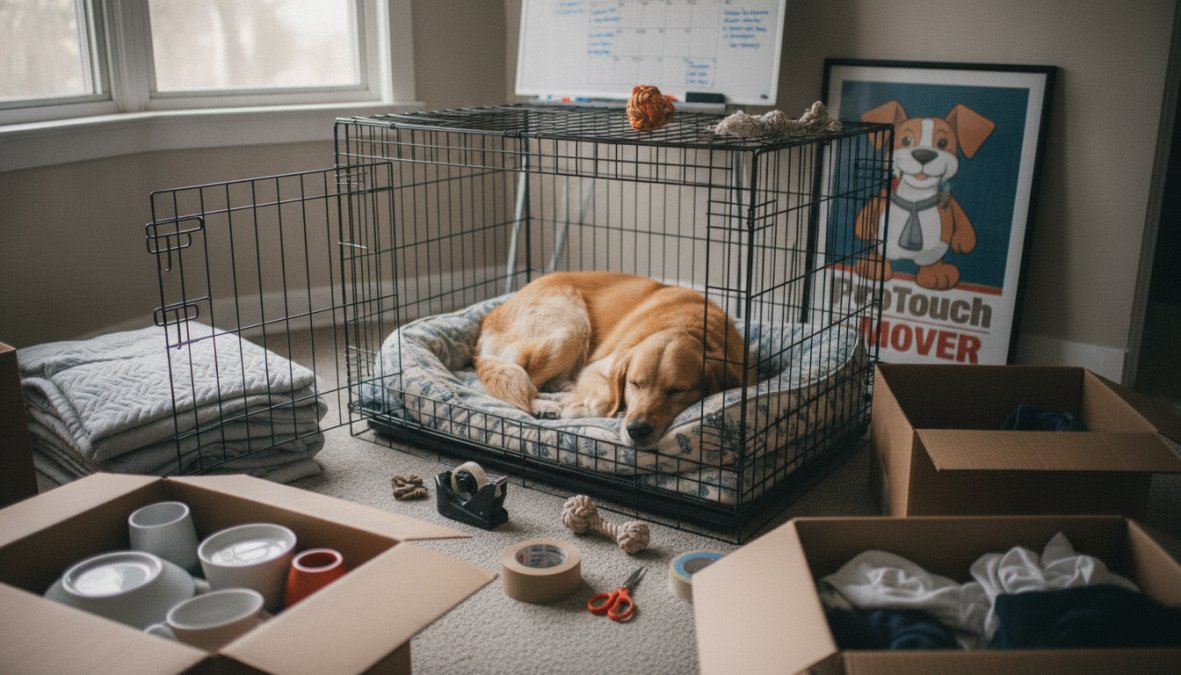
(/blog/your-personalized-guide-to-a-stress-free-move-in-florida/): Practical Stress-Relief Strategies]
Maintain Your Pet’s Routine Before Moving Day
Routine is your pet’s anchor during chaos. Keep feeding times, walk schedules, and play sessions identical to your normal routine for at least 2-3 weeks before moving day. If your new home has different space or layout, gradually adjust your pet’s routine to match what they’ll experience post-move.
Sleep schedules matter significantly. Pets that maintain consistent sleep routines experience less overall stress during transitions. If moving day will be chaotic, arrange for your pet to stay with a trusted friend or boarding facility that day.
Use Calming Aids and Familiar Scents
Calming pheromone products like Feliway for cats and Adaptil for dogs reduce anxiety by mimicking natural calming chemicals. Start using these products 1-2 weeks before your move. Pack a "scent bag" containing items your pet sleeps on, toys they’ve used for years, and anything with your personal scent. During the move and in the new home, these items become anchors to their previous life.
Never wash your pet’s bedding right before a move. The familiar scent is therapeutic.
Start pheromone products 1-2 weeks before your move, not the day of. Your pet needs time to respond to the calming signals.
Pet-Friendly Moving Checklist: What You Can’t Forget
A comprehensive moving checklist prevents last-minute scrambling and forgotten essentials.
| Item | Timeline | Priority | Notes |
|---|---|---|---|
| Veterinary records | 4 weeks before | Critical | Request official copies from current vet |
| Update ID tags | 6 weeks before | Critical | New address and phone number |
| Microchip registration | 6 weeks before | Critical | Verify current contact info in registry |
| Health certificate | 2-3 weeks before | High | Required for state-to-state moves |
| Packing pet essentials | 1 week before | Critical | Food, medications, toys, bedding |
| Pet carrier inspection | 2 weeks before | High | Ensure safe, comfortable condition |
| Arrange pet care for moving day | 3 weeks before | High | Boarding or trusted friend |
| Update vet records with new address | 1 week before | High | Notify current and new veterinarian |
| Pet-proof new home | Before arrival | Critical | Secure loose wires, toxic plants, escape routes |
| Calming aids purchased | 3 weeks before | Medium | Start use 1-2 weeks before move |
Pack an Essentials Bag for Your Pet
Your pet’s essentials bag stays with you during transport, not in the moving truck. Pack enough supplies for at least one week: food, water, bowls, medications, first aid supplies, recent photos of your pet, and vaccination records.
Bring enough of their current food to last at least 2 weeks. If switching to different food at the new location, bring enough of the old food to transition gradually over 7-10 days. Include a first aid kit specific to your pet’s species and recent photos taken from multiple angles, invaluable if your pet escapes.
Create a Safe Space in Your Current Home
Before packing begins, designate one room as your pet’s safe space containing their bed, food and water bowls, litter box, toys, and calming aids. Keep this room closed during packing. Many pets retreat to this space voluntarily during moving preparation. Respect this behavior and never force your pet out of their safe space.
For anxious pets, consider crate training in this safe space weeks before the move. A properly conditioned crate becomes a portable safe space that travels with your pet.
Never force your pet to participate in moving day activities. A stressed pet is an escape risk. Keep them in their safe space or arrange for them to stay elsewhere entirely.
Pet Travel Essentials: Keeping Your Pet Safe During Transport
Transport is where many moving strategies fail. Pet owners focus on packing boxes but neglect the actual journey from old home to new home.
Choose the Right Pet Carrier or Crate
The carrier must be the correct size, large enough for your pet to turn around and lie down, but not so large that they’re thrown around during vehicle movement. For dogs, hard-sided crates are superior to soft-sided carriers during vehicle transport. Hard crates protect your pet if the vehicle brakes suddenly. Secure soft carriers with a seatbelt.
For cats, ensure the carrier has good ventilation and is dark enough to feel den-like. A partially covered carrier reduces anxiety. For birds, use a travel cage with secure latches and include perches at different heights. Cover three sides with a blanket to reduce visual stimulation.
Plan for Potty Breaks and Hydration
Dogs need bathroom breaks every 2-4 hours during long moves. Bring a leash, waste bags, and a portable water bowl. Never leave your dog unattended at rest stops. Offer water frequently in small amounts rather than free access to a full bowl.
Cats rarely need bathroom breaks during transport but should have access to water. Birds and small mammals should have water bottles or hydration sources in their carriers. Never use sedation during transport without veterinary guidance.
Introducing Pets to New Home: Acclimation Strategies That Work
The first 24-48 hours in your new home set the tone for your pet’s entire adjustment period. Behavioral regression is common during this time.
Set Up a Home Base First
Before your pet enters the new home, designate one room as their home base with bed, food and water bowls, litter box, toys, and familiar-scented items. Keep your pet in this home base for the first 24-48 hours, giving them time to acclimate in a controlled, manageable area.
Maintain your pet’s normal routine as much as possible. Feed them at the same times, offer water regularly, and spend quiet time with them. Your calm, predictable presence is reassuring during chaos.
Gradual Exploration and Positive Reinforcement
After 24-48 hours, allow your pet supervised access to one additional room. Let them explore at their own pace. Use positive reinforcement aggressively during this period, reward exploration, litter box use, eating meals, and calm behavior with treats and praise.
For dogs, take them outside on leash for bathroom breaks and short walks. Never allow unsupervised outdoor time until your dog has acclimated for at least one week. For cats, keep them indoors for the first 2-3 weeks before allowing supervised outdoor time.
The first week in a new home is critical for pet acclimation. Slow, controlled exploration with positive reinforcement prevents behavioral regression and escape attempts.
Pet-Proofing Your New Home: Safety First
Walk through your new home from your pet’s perspective. Get down to their eye level and look for hazards. Secure or block any opening larger than your pet’s head.
Check for toxic plants. Lilies are deadly to cats. Sago palms are toxic to dogs. Philodendrons affect multiple species. Research plants in your new home and remove anything toxic.
Inspect windows and doors for secure latches. A stressed pet will attempt escape through any opening. Ensure all windows lock fully and all doors close securely. Walk your property perimeter and seal any potential escape routes. For cats, ensure screens are secure on all windows.
Species-Specific Moving Considerations: Dogs, Cats, and Beyond
Dogs experience moving stress primarily through routine disruption and environmental change. Most dogs acclimate within 2-4 weeks if their routine is maintained.
Cats experience moving stress more intensely than dogs. Cats are territorial, and a complete environment change is deeply stressful. Cats often hide for several days or weeks after moving. This is normal behavior, not a sign of illness. Patience and maintaining routine are essential.
Birds require climate-controlled transport and minimal disruption. Transport your bird in a covered travel cage, maintain consistent temperature, and minimize exposure to loud noises. Rabbits and guinea pigs are sensitive to temperature and stress. Transport them in well-ventilated carriers with bedding material and ensure they have access to hay and water.
Long-Distance vs. Local Move Logistics
Local moves (under 2 hours) are straightforward. Your pet can travel in your vehicle in a secure carrier. Maintain climate control and offer water breaks.
Long-distance moves (over 6 hours) require additional planning. Consider hiring professional pet transport services if your pet has severe anxiety or health conditions. If transporting yourself, plan your route with pet-friendly hotels or rest stops. For very long-distance moves, flying your pet may be safer than driving, though it is stressful for most pets.
Managing Post-Move Behavioral Changes
Behavioral changes after moving are nearly universal in pets. A housetrained dog may have accidents. A calm cat may become aggressive. These changes are stress responses, not permanent personality shifts.
Expect behavioral changes to peak 3-7 days after moving, then gradually improve over 2-4 weeks. Most pets return to baseline behavior within 4-6 weeks if routine is maintained.
Accidents in the house are common in dogs during the first week. Don’t punish your dog. Instead, increase outdoor bathroom breaks to every 2-3 hours and use enzymatic cleaners on accident spots.
Cats may stop using litter boxes during stress. Provide multiple litter boxes in different locations, one per cat plus one extra. Use unscented litter if possible. Aggression or excessive hiding in cats is normal during relocation stress. Allow your cat to hide and emerge on their own timeline.
Appetite loss is common during the first week. Offer favorite foods and maintain feeding schedules. If appetite doesn’t return within 3-5 days, contact your new veterinarian. Destructive behavior in dogs often indicates anxiety rather than boredom. Increase exercise and provide puzzle toys. Sleep disruption is normal. Most pets return to normal sleep patterns within 2-3 weeks.
Moving house with pets requires planning, patience, and flexibility. The strategies outlined above address the most common challenges that prevent complications and reduce stress for both you and your animal companions. ProTouch Mover specializes in full-service residential relocation throughout Jacksonville and surrounding areas, including coordination with pet owners to ensure safe transport and minimal disruption. Get your free moving quote today and let our experienced team handle the logistics while you focus on your pet’s comfort and safety.
Frequently Asked Questions
How do I keep my pet calm when moving?
Reducing pet anxiety during moving house with pets involves maintaining your pet's routine as much as possible, using calming pheromones or supplements recommended by your vet, and keeping familiar scents and toys nearby. Create a designated safe space away from moving boxes and activity. Consider crate training before the move so your pet feels secure in their carrier. For long-distance moves, plan regular potty breaks and keep your pet's schedule consistent. Some pets benefit from mild sedation prescribed by your veterinarian, discuss this option during your pre-move vet check.
What should I pack in a pet's essentials bag for moving?
Your pet travel essentials bag should include enough food and water for the move plus extra days, medications, vaccination records, ID tags with updated contact information, a recent photo of your pet, comfort items like a favorite toy or blanket with familiar scents, grooming supplies, and waste bags. Include your veterinarian's contact information and records of microchip registration. For cats, pack a portable litter box and litter. Keep this bag with you during the move rather than packing it with moving boxes so you have immediate access to everything your pet needs.
How long does it take for a pet to adjust to a new home?
Most pets need 2-4 weeks to adjust to a new environment, though this varies by species and individual temperament. Cats typically take longer than dogs. Start by confining your pet to one room (their home base) with all essentials for several days, then gradually expand their access. Watch for behavioral regression such as hiding, changes in appetite, or accidents, these are normal during acclimation. Use positive reinforcement when your pet explores the new home. Maintain their routine and familiar scents to speed adjustment. If behavioral changes persist beyond a month, consult your veterinarian.
Should I use a pet sitter or boarding for moving day?
For local moves, consider having a pet sitter care for your pet in a quiet, familiar location on moving day to reduce stress from the chaos of moving boxes and crews. For long-distance moves, transporting your pet yourself in a secure pet carrier is often safer. If you choose boarding, arrange it well in advance and visit the facility beforehand. Ensure the boarding facility has your pet's vaccination records and knows about any special needs. Never leave your pet unsupervised during the move, and always update your contact information with any care provider before moving day.
This article was written using GrandRanker